A racing pulse
The body is preparing for threat before the mind has finished interpreting the situation.
The brain system that reacts before you reason: fast, protective, and shaped for survival in a very different world.
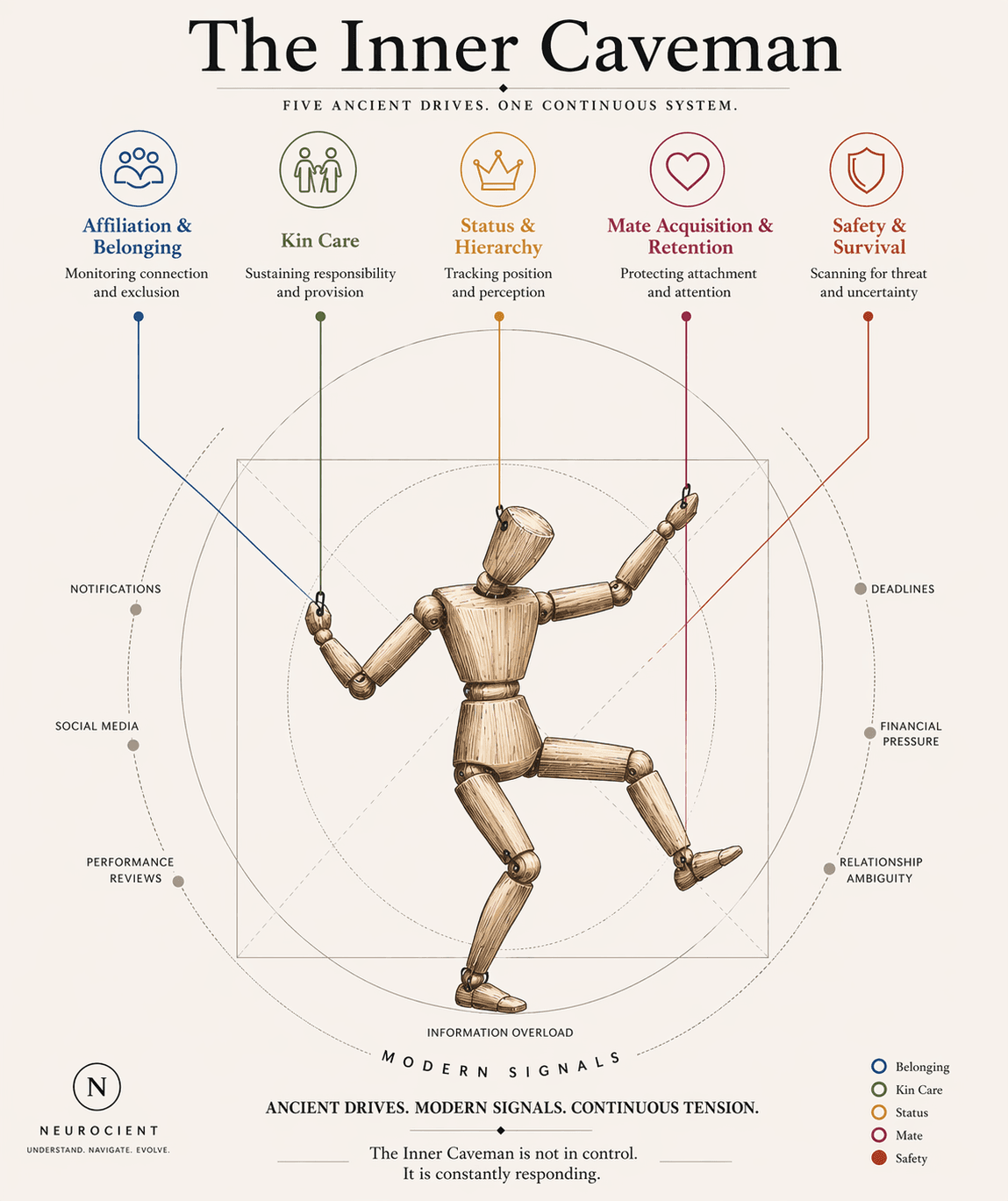
The Inner Caveman is a shorthand for the evolved patterns still active inside modern behavior. It is not a literal anatomical "old brain," and it is not an insult. It is a way to name the fast, protective system that scans for danger, belonging, rank, scarcity, and social safety.
This system helped humans survive small groups, uncertainty, hunger, exposure, and conflict. Today, it responds to deadlines, unread messages, public criticism, comparison feeds, ambiguity, and emotional distance.
The problem is not that you have ancient wiring. The problem is that modern life keeps pressing its ancient buttons.
This is why rational pep talks often fail. The nervous system is not waiting for a better paragraph. It is looking for proof of safety. Until the body feels safe enough, the mind keeps producing stories to explain the alarm.
The body is preparing for threat before the mind has finished interpreting the situation.
The old system has detected quick relief, quick energy, or quick reassurance.
Some part of the next step feels exposed, costly, unclear, or socially unsafe.
The mind may be explaining an alarm that began underneath language.
12-minute audio
A slower conversation for the core idea: why ancient protective patterns still shape modern choices.
Modern culture loves the idea that if you understand something, you should be able to change it. But under pressure, the body often moves before the insight can help. Fear narrows attention. Stress pulls energy toward older protective responses. The part of you that can plan, reflect, and choose may simply arrive late.
This is why the work cannot be only intellectual. Every calm exhale, every smaller first step, every completed action under mild discomfort becomes evidence. The caveman learns through repeated proof that the modern situation is survivable.
Knowledge becomes useful when the nervous system has enough safety to act on it.
Most reactions make more sense when you ask which ancient drive is active. The same moment can involve several drives, but one usually speaks loudest.
Is there danger?
Old logic: Notice threat early, conserve energy, avoid unnecessary exposure.
Modern signal: Procrastination, overthinking, anxiety, defensiveness, and waiting to feel ready.
Am I still included?
Old logic: Stay close to the group because exclusion once carried real risk.
Modern signal: People-pleasing, notification checking, conflict avoidance, and loneliness.
Where do I stand?
Old logic: Track rank because status shaped safety, resources, and influence.
Modern signal: Comparison, performance anxiety, reputation management, and silence after being dismissed.
Are my people okay?
Old logic: Protect the people whose survival was tied to yours.
Modern signal: Caregiving load, guilt, responsibility spirals, and difficulty switching off.
Is this bond safe?
Old logic: Monitor attachment because close bonds shaped protection, continuity, and belonging.
Modern signal: Jealousy, replayed arguments, reassurance seeking, and reading tiny shifts in tone.
Then
A rustle in the grass
Now
A Slack ping, email preview, or unread message
The body prepares before the mind has context.
Then
Visible rank inside a small group
Now
Global comparison feeds and performance metrics
Status tracking becomes endless because the tribe never stops refreshing.
Then
Scarce calories and uncertain food
Now
Always-available snacks, delivery apps, and stress eating
Craving feels urgent because opportunity once had an expiry date.
Then
Short bursts of danger with recovery
Now
Low-grade pressure without closure
The stress system stays open because nothing clearly ends.
Insight matters, but under pressure the body asks a simpler question: is this safe enough to try?
Before fixing the behavior, identify what the caveman is trying to protect: safety, status, belonging, energy, or attachment.
The nervous system responds to evidence, not lectures. Make the next action smaller, clearer, and less socially costly.
Do not rely on willpower alone. Change defaults, cues, friction, timing, and social context so the useful action becomes easier.
Every small completed action teaches the ancient system that this modern situation is survivable.
Free diagnostic
See which patterns show up in your everyday choices: avoidance, comparison, distraction, conflict, and habits.
Start the scanTools
Use spots, microchallenges, nudges, and reflections to turn this lens into small repeatable actions.
Open toolsEssays
Short, grounded essays that explain how ancient wiring appears in modern work, relationships, health, and attention.
Browse insightsThe work is learning to notice a little earlier, reduce threat a little faster, and choose the next useful action before the old pattern becomes the whole story.
So when the old pulse rises — the fear, the craving, the need for approval — pause. That is your oldest self still trying to keep you safe. Thank it. Then remind it: the world has changed, and you can choose from here.
Weekly Insights
Join thousands of readers getting weekly insights on the ancient wiring behind modern struggles and practical ways to work with it. No fluff. No gimmicks. Just science made human.
No spam. Unsubscribe anytime. Read by 4,000+ modern cavemen.