01
Waiting to feel ready
The project, conversation, or change matters—but beginning still feels easier to postpone.
 from your ONE life.
Neurocient helps you understand what's been standing in your way.
& work with it in real life.
A behaviour-change platform to bridge the gap between knowing and doing
See what's underneathSome life experiences make you realize, clearly and uncomfortably, that the life you're living and the life you want are not the same.
Maybe it was watching someone close struggle with their health and realizing you don't want to keep taking your own for granted.
Maybe it was realizing that your close relationships had drifted into the bare minimum, and you don't want to settle for surface-level relationships just to avoid conflict or judgment.
Maybe it was realizing you'd started getting triggered by the smallest things, like you were under pressure all day, every day, and you don't want your body and mind to keep paying the price.
Or maybe it was something else entirely.
Whatever the moment was, it left you with a feeling you couldn't ignore anymore. You wanted to live with more intention and fewer regrets.
So you tried.
Morning routines. Meditation. Journaling. Self-help books. Listening to podcasts. Productivity hacks. Self-help apps.
You knew what to do.
And still—
a few weeks later, you found yourself back where you started.
And you keep asking yourself…
You know what needs to be done. You may even want to do it. And yet, you don't. Not always. Not completely. But often enough to wonder what's really going on.
Over time, it becomes frustrating. You stop asking why you can't seem to make things stick, and start wondering if something is wrong with you.
You tell yourself next week will be different. After this project. After the holidays. Once work settles down. Once life feels less busy. But somehow, that version of your life never arrives.
Instead, the same struggles keep showing up in different parts of your life. Some are obvious. Others become so familiar that they start to feel like part of who you are.
Here are a few patterns you might recognize
The project, conversation, or change matters—but beginning still feels easier to postpone.
You pick up your phone for a moment and stay long after you meant to stop.
Someone else’s progress changes how your own life feels, even when nothing in it has changed.
Even during rest, unfinished tasks keep running through your mind.
You replay conversations and prepare for problems that have not happened.
Another plan slips, and the disappointment begins to sound like a judgment about you.
These patterns may look different from person to person.
But if you've recognized yourself in even one of them, you've probably already searched for answers and followed more advice than you can remember.
When something isn’t working, the response is almost automatic.
And for a while, it does help.
You organize the list. You set the plan. You feel a brief sense of control.
But it doesn’t last.
help organize what to do, but it doesn't explain why the work feels difficult to do in the first place.
Create short bursts of energy. When the initial excitement wears off older patterns take over again.
pushes you to do more. When the willpower runs out you are back to where you started.
None of these approaches are wrong.
So…why does none of it stick?
Because…they assume that once you know better, you will do better.
But that is not how it plays out.
You can understand exactly what needs to be done, and still feel a quiet resistance pulling you away from it.
So the cycle repeats.
And slowly, the problem starts to feel like you.
If this sounds familiar, take a deep breath. You’re not alone. And more importantly…
The gap between knowing and doing isn't simply about willpower, discipline, or motivation.
What happens underneath
Human brains also make fast, automatic judgments about:
Those judgments can shape what happens before deliberate reasoning catches up.
An uncertain task
Delay it until the pressure or the next step becomes clearer.
Someone else moves ahead
Check what their progress might mean about your own standing.
A tense conversation ends
Replay it so the uncertainty does not disappear before it feels resolved.
The response may be automatic. Its effect on your life is real.
Neurocient starts here: not by asking you to try harder, but by helping you see what is shaping the behaviour and then work with it in real situations.
Then it helps you apply those insights in everyday life, so change actually lasts.
To make lasting change, the first step is awareness.
Not just of your behaviours, but of what is driving them.
Begin with the system shaping the response.
The brain system that reacts before you reason: fast, automatic, and shaped for survival in a very different world.
It is not a villain. It is not something you need to get rid of. It is Neurocient's name for evolved automatic processing: fast, reactive, energy-saving, and shaped by recurring human problems across many generations.
The patterns you recognised earlier—waiting to feel ready, escaping into the scroll, comparing yourself with others, constant pressure, worries that never leave, and guilt—can be different ways automatic processing responds when one of five recurring human concerns becomes salient.
Those concerns usually fall into five core drives.
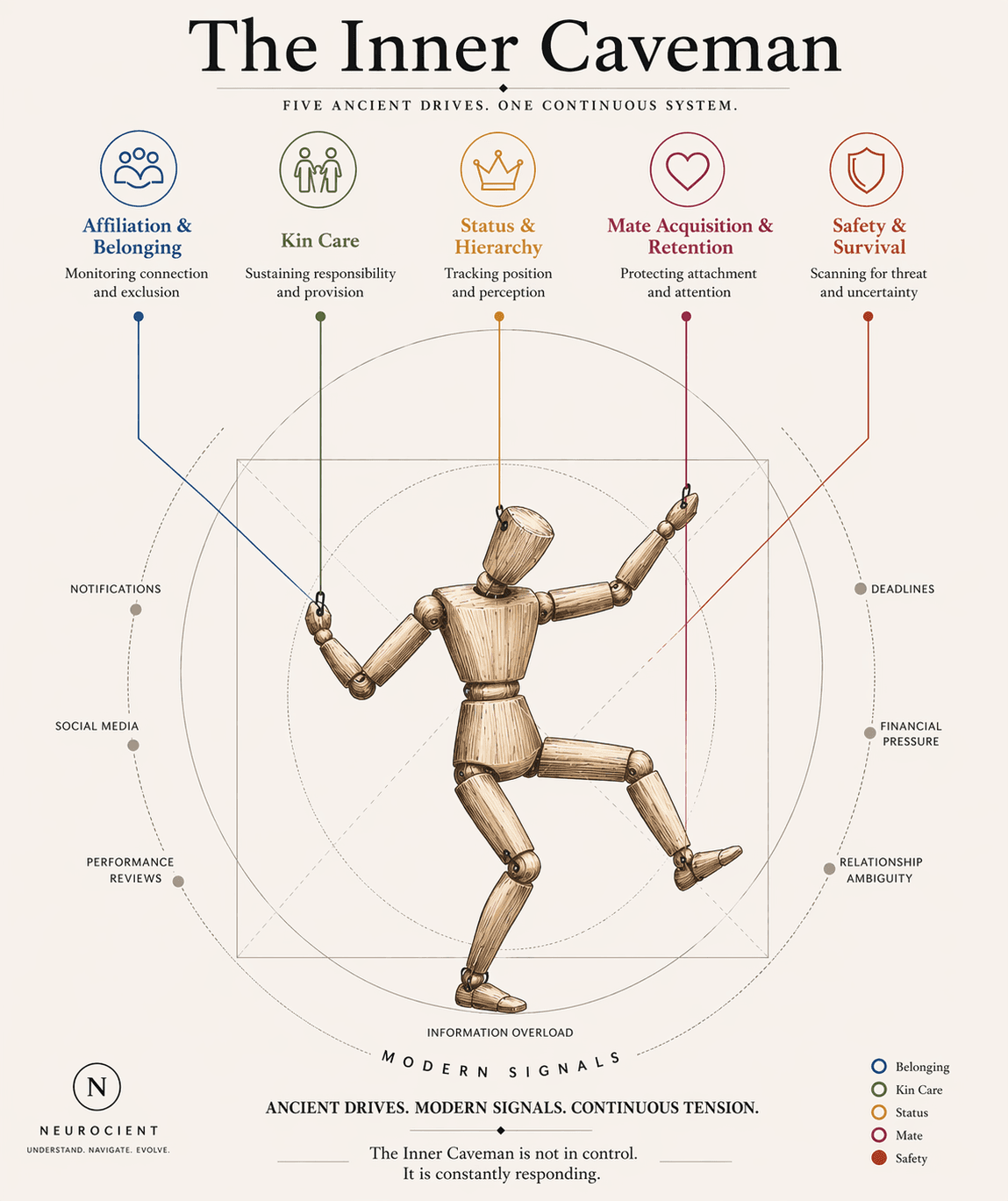
Am I included?
Notifications, social media, loneliness, team silence.
Are my people okay?
Caregiving, provision, responsibility, emotional load.
Where do I stand?
Performance reviews, comparison, reputation, visibility.
Is this bond safe?
Attachment, ambiguity, jealousy, replaying arguments.
Am I safe enough?
Deadlines, uncertainty, anxiety, avoidance, overreactions.
Every person has all five drives. Different situations activate different drives, shaping how you think, feel, and respond.
You can't delete your Inner Caveman.
But you can learn to
recognise when automatic processing is shaping the response,
understand which signals are receiving more weight,
and respond with more awareness instead of reacting automatically.
From recognition to change
Seeing the pattern changes the question.
How do you turn that understanding into lasting change?
Understanding is not the finish line. Neurocient helps you move from something you understand to something you live.
Understand
Begin with a behaviour you cannot quite explain and follow what is happening underneath it.
For scrolling, comparison, worry, avoidance and other familiar situations.
Explore InsightsNotice and experiment
Capture what happened in a real situation, then try one modest change in the conditions around it.
Spot the Inner Caveman and Microchallenges turn a vague difficulty into usable evidence.
Explore ToolsWork through it
Use a guided sequence to work through one recurring behaviour without jumping straight to another action plan.
Practice brings Identity, Knowledge, Environment, Action and Reinforcement together.
Open PracticeAdd human support
Use live structure and facilitation when self-guided understanding is not enough for the change you want to make.
Personal guidance and workplace programs offer different forms of support.
Explore ProgramsInside guided Practice
Loosen the story the behaviour has created about you.
Understand the immediate logic beneath what happens.
Change the conditions making the old response easier.
Choose the smallest useful move that fits the cause.
Bring the insight back when the situation returns.
Not sure where to start?
Begin with ordinary situations from your own life. Free · about five minutes.